Showing posts with label ARLIS. Show all posts

Tuesday, 25 July 2017

Arlis Conference Dublin 2017

This is my report for the Arlis conference, which I also submitted to the Cambridge Libraries Newsletter (doesn't include the edits they made). With the year now corrected (oops).

ARLIS Conference Dublin 2017: [R]evolution: Re-imagining the Art Library

The Art Libraries Society (Arlis) conference took place at the National Gallery of Ireland in Dublin this July. Always a glamorous and intellectually stimulating conference, this was no different; the Irish contingent put on an amazing show, ably assisted by the many wonderful galleries and libraries Dublin has to offer.

Francis Bacon's Studio, at Dublin City Gallery
 Popular themes this year included discussion of space, in its physical and digital sense, and of the library as the potential third space. One particular highlight was Daniel Payne of OCAD University in Toronto and his talk in the dissonance between perceived space, cognitive space and physical space, and how harmonising these can lead to a sense of place rather than space. Another was an excellent lightning talk from Nicole Lovenjak, one of the authors of the recently published The State of Art Museum Libraries 2016 White Paper – fascinating, if rather depressing, reading. She had recently worked as a consultant on the planned closure of Dayton Institute Library and dispersal of its contents, and had effectively rescued archives of unique material which might otherwise have been lost.

This was also my first foray into conference speaking, so I gave a lightning talk entitled Doing More With Less – which certainly seemed to strike a chord with the audience! It led to lots of interesting conversations with all sorts of librarians, so I’m grateful for the opportunity (and that’s another thing to tick off on my bucket list!).

The Cathach, the earliest extant example of Irish
writing (c.560-600AD), at the Royal Irish Academy
And it wouldn’t be an art libraries conference without taking in at least one art exhibition, so we enjoyed a prosecco reception and a special viewing of Vermeer and the Masters of Genre Painting at the National Gallery, and visits to places like the Royal Dublin Society, Chester Beatty Library, the Royal Irish Academy and Dublin City Gallery, which houses Frances Bacon’s studio. Sheer indulgence!


So yes. Maybe you didn't spot it, but I GAVE A PRESENTATION. Me. Okay, only a lightning talk, and not a terribly brilliant one at that, but the important thing is I got up in front of my peers and delivered something with the assumption that I would be imparting information that they hadn't heard before. Take that, imposter syndrome!

It was good, although in hindsight I probably dwelt too much on the problem rather than the outcome, meaning a lot of people came up to me to offer sympathy rather than congratulations. However, in all of that, I got a tweet (look! I quote: "#neverknew"!):
And even better, the director of Arlis himself asked me for advice on something. Score!

Next step was to write about it publicly: Cambridge Libraries Newsletter ✔
And I mentioned it to the assistant director here, and she suggested I write something about it for the UCM Blog. It's not going to be a conversation with a woolly bear, but they might still publish it...

Tuesday, 4 April 2017

CPD catch-up

I emailed our HR recently, because they were asking what courses and training I'd been doing. When I made the list of things I'd done/attended/learnt over the course of the last 15 months, it actually came to quite a lot. As in, nearly attachment-worthy-size!
I've done some stuff, I'm planning on doing more.
I guess you could say I've been pretty busy. To my utter delight, I've also been pretty organised about it. Turns out I'm not the best at Bullet Journaling, although I am the king of To-Do lists. I've got a bullet journal, and I take it everywhere. I don't use it for keeping appointments, or as a diary, and the idea of trying to keep track of my frequent targets is one which is slowly falling by the wayside (though it does force me to look back and say "no I really do have to do that someday...just not now"). But it's brilliant as a notebook, and I've found writing everything in there from meetings, courses, training, lectures, etc etc etc...it just keeps it all in the one place. I know damn well where my notes are now, and I don't have to look in one place for CPD notes, then in another for meetings (and hope that I've remembered right). And it's chronological, so I can just check the dates on the index, and list everything there. So I did.
Goals for the month: 1. Write a list of goals for the month.
Since the conference I haven't let the grass grown underneath my feet. First of all we presented to CLAG, then FDL and CCLF, about the conference, how it went, what went on behind the scenes, and our thoughts for the future. You won't be surprised to know we're already thinking about next year's conference, and how to make it even better than this year's! But in addition to this I've gone to two training sessions; one on fundraising for library projects, and one on writing engaging content for blogs (This is the bit where you're supposed to say "But why would you need that? You're entertaining already!" Guys? Helloo?), and I've just started a 4-part library carpentry workshop.
In addition to this (but completely non-work-related) I've just finished a 4-part session on sewing, run by our local children's centre. I must really like learning stuff!
I made these!
Fundraising for Library Projects was really interesting. We had talks from three people, one who works to raise funds for library projects at the UL, one who became a bit of an accidental fundraiser for King's College Library, and one who has to try and convince people to spend fortunes on a database which equates to a cost of nearly £800 per user! Each had some really interesting points to communicate. For me there were several take home messages, such as: come at the fundraising from the donors' point of view - their reasons for giving can be quite diverse and may not perfectly line up with why you're trying to raise the money, which means adapting your message to suit them. Another is to really consider whether the return on investment is worth the effort - there is a lot of failure involved, so is it worth you losing your time to fundraising efforts instead of spending it on your regular work? Also helpful was talking to the other attendees, who could share their experiences of fundraising and finding suitable projects. This was a great session, and I would recommend it if it's repeated.
Aligning aims with those of the donor is very important; I look forward to advancing and perpetuating humanistic inquiry with my digitisation project.
The other session I attended was Writing Engaging Content for the New UCM Blog. UCM is the umbrella which covers all the university museums and the Botanic Garden, and their blog is about to be relaunched. I thought there would be a lot I already knew, but there were some surprising gems I'd not thought about before, such as coming up with lots of titles in order to find the perfect one. It was interesting learning from someone who doesn't come from an academic background, as there are some practices prevalent (and useful) in academic blogs that she encouraged us to eschew for communicating on the UCM blog - such as citations, which I think are often necessary! Was it a good session? Well, yes, I guess. I have to admit I felt a bit flat when we shared our blogpost ideas - the course leader was very enthusiastic about most of them, saying things like "I definitely want to read this!" and "Please write that one!" - and when she got to me her response was "Can it be linked to anything else?" But there was another librarian there, and she told me how much she'd enjoyed the Cambridge Libraries Conference this year, so that cheered me up.
Apparently letters from Queen Mary aren't blog-worthy unless there's something more interesting they can be linked to.
So there's a lot to come. I'm going to be presenting a lightning talk at ARLIS in Dublin this July, which is so far out of my comfort zone I can't even see the zone anymore. I'll have to write that, then I still have IAML in Exeter (maybe), and Library Carpentry homework to do, and I've just sent out a survey to the staff here about what to put on our quick reference shelves - I was surprised (in a good way) by the number of responses! Maybe there's hope for UX in this library yet..

Wednesday, 3 February 2016

Introduction to Art and Design Resources - an Arlis Workshop

Two posts in as many days? Only because I needed to write about this one immediately so I had to deal with the backlog from all my earlier CPD...(all one of it. Ahem).

Yes, it's been a busy time, but not with work. I've become a parent, and discovered that apparently the feeling that I had no time at all before is nothing like the feeling that I have no time at all now. Fortunately at work I currently have a temp to help me with collection management and other projectwork, which means we're almost treading water sufficiently that I'm slightly more freed up to attend things which will, in the long run, make our job slightly easier anyway.

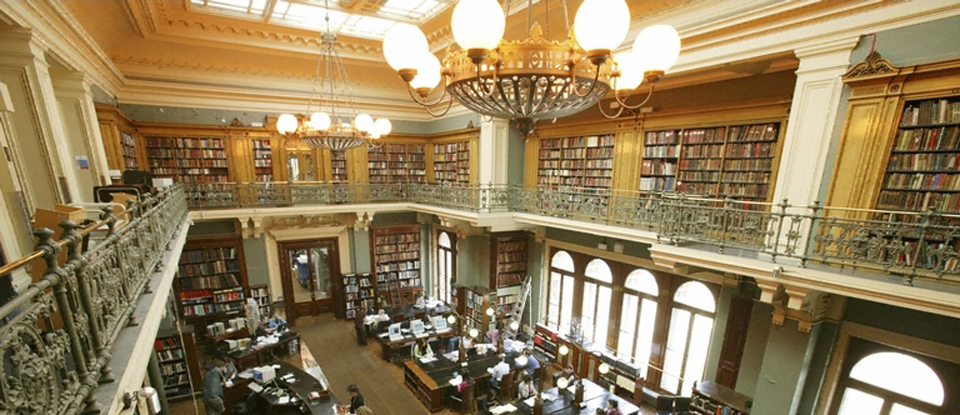
The National Art Library (c)V&A
This was one such event: on Monday 18th January I travelled down to the National Art Library in the V&A for an Arlis workshop. It was an all-day event, and I stayed for everything except the final tour of the National Art Library (getting back in time to pick up the little one from nursery would have been tricky had I stayed).

The library appeared pretty well appointed - they have numerous terminals for readers, with access to lots of online resources. In addition the shelves are full of materials, and there's more in the rolling stacks. They even have a seminar room, where we had a networking lunch - yes it was a little bit cold in the room, but at least they have one! I was very envious - and I think if I ever do go on a tour there, I'll only become more so. Nonetheless, I should try and arrange another visit sometime, in order to learn more about their work and where their collections can support ours.

The event itself consisted of several presentations from a range of libraries, and a hands-on task:

  • Enquiry work in an art and design museum (Bernadette Archer, NAL)
  • Enquiry work in an academic library (Cathy Johns, RCA)
  • Practical session on enquiry referral work: specialist sources (Yamuna Ravindran)
  • The future is paperless! (But the present still needs 3 x 5 cards...) (Joseph Ripp, NPG)
  • Finding connections - art, artist and audience (Jane Bramwell & Allison Foster, Tate)
The reasons for my wanting to attend were multiple.

1. To fill in the gaps in my knowledge and use of standard art resources 
I found Bernadette's talk particularly useful here. She talked about how the NAL deal with their enquiries, which are massively diverse. At the end she supplied a brief analysis of some of the resources they used. A lot I'd come across or use regularly, but there were a few resources I wasn't aware of which seem useful for the library here. The Guide to the Literature of Art History is one such - our reference collection is based both on the museum collections and the interests of the keepers who curate them. When a keeper is replaced, the new keeper will bring new and different specialisms to the museum, which may not be well catered for in the library, so this book is a great starting point to ensure that we have the fundamentals covered.
Success? Yes, lots of good information here, including where to go when I don't know the answers.

2. To ensure my current awareness is, well, both current and aware!
I think I didn't really learn about much here, which either means I'm sufficiently up to date, or that it wasn't really covered. There was again a lot of useful information in Bernadette's talk, with online resources that she uses, and their limits and strengths. EBSCO: ArtSource was recommended as being the most useful, but ProQuest and various other databases were mentioned too, the majority of which we have access to through the University Library.
Success? Yes, I think so. The UL keeps us well-covered for e-resources (although it doesn't subscribe to either AKL or Benezit online. Luckily, we have the hard copies).

3. To test out any resources before potentially purchasing them for my library
This was quite successful in one sense, in that during the hands-on session we made use of the many e-resources offered by the NAL. As museum staff had been asking for access to art valuation websites, I was particularly pleased to have a go with Art Price. However, buoyed up with the possibility of subscribing to this, I later found out that someone in the museum has a personal subscription and everyone gets him to do the searching, so "no need to waste the money". I must admit, I feel a bit flat when people find ways to avoid asking the library for things.
Success? On the day, absolutely. In the end, it turned out more irrelevant than I'd've liked. =(

4. To gain contacts in the area, particularly within museum libraries
I'm really not great at networking. I talked to a couple of people, including someone from The Goldsmiths' Company and a couple of university arts librarians. I thought it was interesting that speakers from museums tended to be people who worked with archives or collections that were considered special in their own right - I'm certainly not in that situation here, so it would be more helpful to make connections with other museum libraries more like mine, assuming there are any!
Success? Low to moderate. I need to be braver!

5. Finally, to raise the profile of my own library amongst those outside the university who might find it useful as a resource
Again, I wasn't great at promoting this library. One thing I hadn't realised was quite how extensive the National Art Library's holdings are when it comes to auction catalogues. They have a lot from overseas, whereas our collection only really focuses on UK, with sporadic German catalogues of antiquities, and the odd French, Chinese and Japanese catalogue from the bigger auction houses. However, I know for a fact we have items in our collection which fill gaps in theirs (and probably vice versa), so the sooner we get our volunteer cracking on the dealers' catalogues project, the better. After this, I am keen to investigate getting our records onto COPAC (currently the UL is there, but none of the other libraries in Cambridge, I believe). The library holds collections of items not readily available elsewhere in the country, so we could do a lot to support scholars from outside Cambridge if only they knew about it as a resource.
Success? Low. Getting our collections visible on the web will do more, I think.

On the whole, more successes than failures (and nothing was really a total failure). Definitely worth going on the course, and I'm very grateful to my line manager and the HR manager at work for supporting me and allowing library budget to be put towards this useful training.

Friday, 25 July 2014

ARLIS 2014: The Journey Continues

Two things I did at the conference I didn't write about in the last post because I wanted to give them a fair hearing: the visit to the John Rylands Library and the break-out sessions I attended.

The visit to John Rylands is mostly just pictures. Someone else wrote about it, and made notes on all the facts during the tour, so I didn't bother, I just snapped the things that interested me.

We started here, at the sculpture of Archimedes. Some wag had left a deflated balloon hanging out the corner of his mouth.
We walked past Chinatown, which is the second biggest in the UK (after London) and has the second biggest gate in the UK (after Liverpool).
The round Central Library, just peeping out from behind the other building there.
And here is the John Rylands Library, looking very imposing.
My phone isn't great with handling bright lights and dim corridors, so lots of blurriness I'm afraid. We meet Stella Halkyard, the Visual Collections and Academic Engagement Manager.

We're taken round some of the exhibition spaces. Some are rotated fairly frequently, while others are only removed for conservation care.

The very grand entrance hall - much more forbidding than the modern bit they've attached now!
This is the Historic Reading Room. We were given a lot of the history of the building, and John Rylands' wife, who sounded a pretty imposing figure!


Now we get to the really interesting, behind-the-scenes stuff. One of the issues is that over the years, librarians knew how to deal with the books that came in, but there was a more haphazard approach to images and other non-book items, so we learnt a bit about the challenges Stella faces.
Although you can't really tell, the floor here is glass, to allow light through three floors of bookstacks! In the right spots, you can see down past the floor to the storeys below. The ceilings here were really low.
An interesting door. Taking this picture I nearly got locked into the basement stacks!
One of the original toilets (I think)!

I did enjoy the Victorian Neo-Gothic architecture, although being so used to the really old buildings round Cambridge I couldn't help but feel that it just didn't look crumbly and dilapidated enough! It was really interesting finding out about the history and ethos of the library, and what they're doing in outreach now. If Manchester was a bit closer, I'd definitely try and come along to one of their workshops, which sound like a lot of fun.

Break-Out Sessions

I attended Gaming in the Library and the Update to RDA - one for me, one for my work! The RDA update was really useful, even though we were a very small class, and I learnt about forthcoming opportunities to improve my RDA knowledge and practice, and about resources already available. I'd never heard of the Yellow Book (Art exhibition documentation in libraries), which I've now ordered for my library. Also if I can spare the budget I think it would be really useful to have the print copy of the RDA Toolkit, since I get logged out of the online one entirely too often!

Gaming in the Library was interesting too. The slides are available from the link in my previous post, but I also took a few pictures of some of the games Andrew Walsh brought with him.
These are Library A-Z cards, which we used as visual cues for challenges we face in our work. We had to pick a picture that spoke to us, and explain what it meant and what challenge it represented. This method works as a safe space to talk about things and make them less scary, and apparently works really well with Lego, and getting people to build the challenges.

These are two of the card games. The first was designed to teach students how to build references correctly, and the second a quiz to test information literacy. There was also a Top Trumps style game, Top Resources, where students could fill in the cards with the resource they were using, and give it marks on ease of access, breadth and depth etc.

The point Andrew made was that playing these games would take about as long as lecturing students on resources or skills, but by playing the games, the students are more actively engaged in their learning and therefore more likely to take on board the message behind them.

After that he discussed gamification - using gaming mechanics in non-game environments. I have to be honest here, I loathe gamification. On the one hand I'm too competitive and perfectionist, which means I get sucked in unwillingly and will do all the ridiculous things necessary to get 100% on everything. On the other hand, I'm really not a social gamer *at all*. I'm not interested in seeing how I compare to other people, and my favourite games are single player.

So something like Lemon Tree, which is gamification of library usage at the university, seriously wouldn't appeal to me (or at the most I'd try it out, quickly get really annoyed with it and delete it or never use my library card again). However, for those people who enjoy that sort of thing, I guess I can see how it works, and best of all (imho), it was entirely optional for the students.

ARLIS 2014: Reaching New Peaks

For about the last three years, since I took over running the library from my predecessor, I've often felt I've been playing an arduous game of catch-up. On the face of it I've been running this place in much the same way, with certain things improved (like unique classmarks for different books) and cataloguing certain things which needed to be made more visible, like our collection of Sotheby's and Christie's catalogues, but underneath the surface I have been scrabbling around like a mad thing, trying to find out everything I need to know to actually do a good job, not just as far as the staff here are concerned, because let's face it, none of them are librarians and don't actually know how great a resource it could be.

ARLIS was one of those things under the surface - I'm a relatively new member, and a personal one at that. Work doesn't appear to have ever bothered with it, nor the librarian, which meant it was very difficult to justify to my line manager exactly why we needed to join up. I gave up trying in the end, and just joined for myself. The worst part was, I'd never even heard of it until a passing comment from one of the librarians at the Faculty of Architecture and the History of Art*. I don't know why it hadn't occured to me that such a thing might exist - after all, I knew about IAML, and BIALL, and there'd even been a conference in Cambridge when I was working in an art library - how had I missed that?!

Manchester, by PimlicoBadger
Anyway, though I'm seriously pants at networking, often the best bit about going to conferences is talking to people and making new contacts. I felt like I owed it to the library to try and put us on the radar a bit, so that was one of the aims, to say to people "Hi! My library exists!" The second aim was to learn as much as I could about all the things I should be doing and don't know to do - all those unknown unknowns, as Donald Rumsfeld might call them. Thirdly, in addition to telling people about me and my library, I wanted also to find out about them and their libraries, and perhaps organise some visits to libraries like mine, to find out how they cope with challenges similar to the ones I face. And finally, one of the breakout sessions was on Gaming in the Library. I'd seen so much about this sort of thing happening all over Twitter, and was insanely jealous at the thought of all these people getting to play with Lego and calling it work, and was keen to find out more!

Sweet stash!
So off I went, daunted at the prospect of driving 4 1/2 hours, alone, to a place I hadn't been to since I was about 15 (and only to visit MUFC's ground and get my shirt personalised with Cantona's name and number), to spend the next three days with about 70 strangers. Why was I doing this to myself again? It wasn't even as if work was paying for it either! Anyway, I arrived, registered, and made approving noises at the quality of freebie stash, including a pen that lights up when you hit someone something with it, and got started on my Arlis Adventure!

There were so many talks from a wide variety of speakers - lecturers, researchers, students, artists, curators and librarians, that to try and list them all would just take far longer than I can stand to write, and - I'm sure - you can stand to read. The programme is available, and I think different people are writing up each session for the Arlis newsletter, so I won't try and describe every single session, just the points that I took home.

Some of the things libraries can do really well
The keynote speech: "Library Futures: Opportunities Not Threats". The speaker was pretty controversial, coming to a subject-specific conference and telling us they'd got rid of all their subject librarians (except for music and foreign languages). However, there was also a lot of value in what she had to say. One point she listed everything that librarians and libraries can be good at - I think I got most of them down. Another point I thought was important was that the library strategy should be bold and align itself stringently with the strategy of the parent institution. Theirs stated: "The library will be vital to [achieving this stretch goal]" - very bold indeed! Finally she stated that libraries should be considered partners, not servants, by their institutions. How much would I love this to be the case here?!

This was from a talk about the refurbishment of Manchester Central Library. Their music library now has guitars and drums for silent playing as well as keyboards - brilliant idea, and I would love to see this in Cambridge Central Library too!

This was a lovely illustration of the sort of work that The National Archives does (although the speaker took great pains to assure us she'd never seen an archive quite in that condition!). I had no idea they were part of the Ministry of Justice, which I suppose makes sense when I think about it, but I was surprised to learn this.

The release of what sounds to be a wonderful resource: The Art Discovery Group Catalogue, which indexes the holdings of 60 art libraries around the world. Promote this to your users! Apparently they're exploring solutions for libraries with significant art holdings within a larger general collection too.

For the visits, I went on the tour of John Rylands Library, which I'll cover in a separate post, along with the breakout sessions. The conference reception and dinner on the second night was held at Manchester Museum, which has some fabulous natural history collections.

Meet Stan
Here's Stan, the second most complete T-Rex in the world, with the most complete skull.
I think this was Percy, it might
have been the other one though..

And there's Percy the Plesiosaur.

Definitely an interesting place to have a dinner!

Finally a couple of points from the Library Impact Data Project talk. I'd seen some earlier findings presented at a lib@cam conference a few years before which were really interesting. Of course, correlation does not equal causation, but when evidence strongly suggests that people who use libraries will get better degrees, that's a good position to start from in discussions at your university. Even more powerful was the statement that those who do not engage with their library at all are more likely to drop out of university entirely! There's a follow-up project happening now, JiscLAMP.

What did I learn? Here are my final thoughts and findings:
  • There was a lot of value placed in kinaesthetic learning, and being able to handle things, not just look at them - this from all the academics, students and librarians present, and not just those from art backgrounds.
  • There was a definite tension between the need (and desire!) to provide a personalised/boutique service a la Priestner & Tilley, and the fact that art libraries are being marginalised or lumped in with other services.
  • I learnt there were specific needs that art-related subjects have that other subjects don't - for example, most art books are massive, therefore art students need more deskspace!
  • One librarian said she felt "bruised, damaged", from having to fight the same battles over and over again, and this conference was a way of rediscovering the passion she had for the job. It was nice that we could support each other, but at the same time I think it's really sad that we do have to constantly defend the existence of even the really specialist libraries with unique and significant collections.
  • A lot of non-librarians were keen to impress upon us just how vital the library collections were for their work - both as research material and as a source of inspiration - and informed us it wasn't just librarians who are passionate about the collections!
  • I couldn't help but notice the not-insignificant North American contingent of librarians, which says a lot about the quality of the conference, I think. Also enabled wider sharing of experiences and expertise, which was great!
  • I got to meet lots of librarians and information professionals from a wide variety of institutions - mostly universities, but also the Henry Moore Institute and the Scottish National Gallery. But no two university art libraries seemed alike either, covering a wide range of subjects too - art history, visual arts, 3-D arts, fashion design, architecture...
All in all, it was a great opportunity. I met lots of wonderful people, learnt lots of new things, and about key resources I'll want to try and obtain for my library. It was a valuable half-week away, and hopefully I can get involved again next year!


*Incidentally I found out about the existence of the Faculty and Departmental Libraries meetings the same way - but much more recently. I still need to find out where Basecamp actually is too.

Final Thoughts

Made it! So, in the end, what do I think? Image by Ralf Kunze from Pixabay I did this as a way of trying to stay connected with my l...